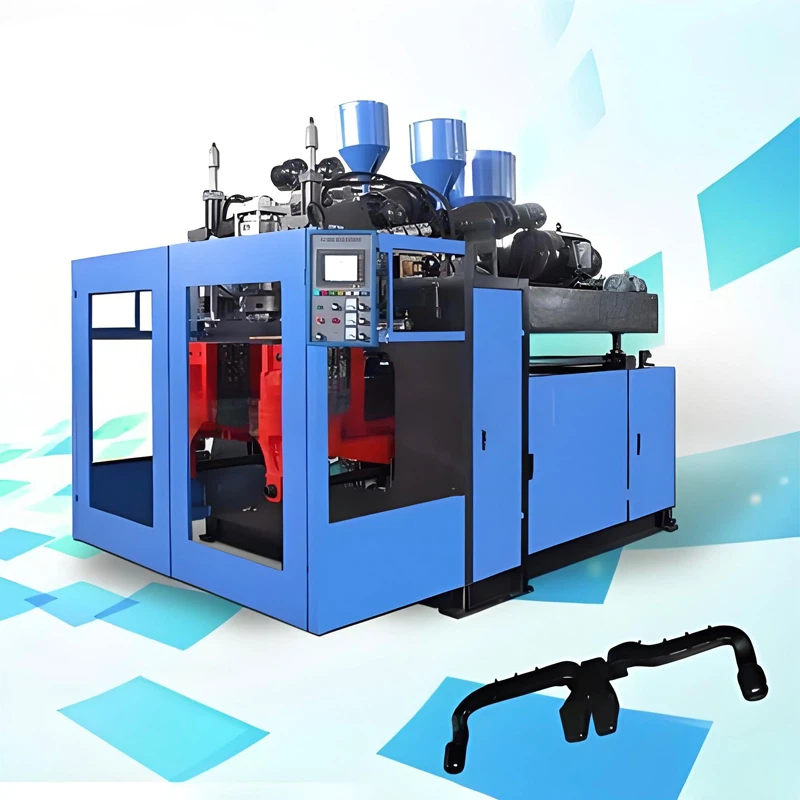
Hey there! I'm a supplier of 10 Litre Blow Moulding Machines. Today, I wanna chat about the production cost per unit of products made by these machines. It's a topic that many folks in the industry are super interested in, so let's dig right in.
First off, let's understand what a 10 Litre Blow Moulding Machine is all about. This type of machine is used to create hollow plastic products with a capacity of 10 litres. You can make things like buckets, containers, and barrels. There are different kinds of blow moulding machines out there, like the Large Blow Molding Machine, Automatic Extrusion Blow Molding Machine, and Chemical Barrel Blow Molding Machine. But for the sake of this discussion, we're focusing on the 10 Litre ones.
Now, when it comes to calculating the production cost per unit, there are several factors we need to consider.
1. Raw Materials
The cost of raw materials is a major chunk of the production cost. For blow moulding, the most common raw material is plastic resin. The price of plastic resin can vary widely depending on the type of plastic (like HDPE, LDPE, or PVC), market demand, and global supply.
Let's say we're using HDPE for our 10-litre products. The current market price of HDPE might be around $1.5 per kilogram. For a 10-litre product, the amount of plastic needed depends on the thickness of the walls and the design of the product. On average, a 10-litre plastic container might use about 1.2 kilograms of HDPE. So, just for the raw material, the cost per unit would be 1.2 x $1.5 = $1.8.
2. Energy Consumption
Blow moulding machines consume a fair amount of energy. They need electricity to run the motors, heaters, and other components. The energy consumption of a 10 Litre Blow Moulding Machine depends on its size, the efficiency of its design, and the production speed.
Let's assume that our machine consumes 5 kilowatt-hours (kWh) of electricity to produce one unit of the 10-litre product. If the cost of electricity is $0.15 per kWh, then the energy cost per unit is 5 x $0.15 = $0.75.
3. Labor Costs
Labor is another important factor. You need workers to operate the machine, monitor the production process, and do quality control. The labor cost per unit depends on the hourly wage of the workers and the time it takes to produce one unit.
If the workers are paid $15 per hour and it takes 0.1 hours (6 minutes) to produce one unit, then the labor cost per unit is $15 x 0.1 = $1.5.
4. Machine Depreciation
The 10 Litre Blow Moulding Machine itself has a cost, and over time, it loses its value. This is called depreciation. To calculate the depreciation cost per unit, we need to know the initial cost of the machine, its expected lifespan, and the number of units it can produce during that lifespan.
Let's say our machine costs $50,000 and has an expected lifespan of 5 years. Assuming it can produce 100,000 units in its lifespan, then the depreciation cost per unit is $50,000 / 100,000 = $0.5.
5. Maintenance and Repairs
Machines need regular maintenance to keep them running smoothly, and sometimes, they break down and need repairs. The cost of maintenance and repairs per unit can be estimated based on past experience or industry standards.
Let's assume that the annual maintenance and repair cost for our machine is $5,000. If it produces 20,000 units per year, then the maintenance and repair cost per unit is $5,000 / 20,000 = $0.25.
6. Tooling Costs
The molds used in the blow moulding process are also a cost factor. Molds need to be designed, manufactured, and sometimes replaced. The cost of a mold for a 10-litre product can range from a few hundred to several thousand dollars, depending on its complexity.
Let's say the mold costs $2,000 and can produce 10,000 units before it needs to be replaced. Then the tooling cost per unit is $2,000 / 10,000 = $0.2.
7. Overhead Costs
There are also overhead costs like rent for the factory space, insurance, and administrative expenses. These costs are usually spread out over all the units produced.
Let's assume that the total overhead cost per year is $20,000, and the machine produces 20,000 units per year. Then the overhead cost per unit is $20,000 / 20,000 = $1.
Total Production Cost per Unit
Now, let's add up all these costs to get the total production cost per unit:
- Raw Materials: $1.8
- Energy Consumption: $0.75
- Labor Costs: $1.5
- Machine Depreciation: $0.5
- Maintenance and Repairs: $0.25
- Tooling Costs: $0.2
- Overhead Costs: $1
The total production cost per unit is $1.8 + $0.75 + $1.5 + $0.5 + $0.25 + $0.2 + $1 = $6.
It's important to note that these are just rough estimates. The actual production cost per unit can vary depending on many factors, such as the efficiency of the machine, the quality of the raw materials, and the local market conditions.
If you're in the market for a 10 Litre Blow Moulding Machine, or if you have any questions about the production cost per unit, feel free to reach out. We can have a detailed discussion and see how we can help you optimize your production costs.
References
- "Plastic Blow Molding Handbook" by John Beaumont
- Industry reports on plastic resin prices and blow moulding machine technology
So, if you're interested in purchasing a 10 Litre Blow Moulding Machine or want to learn more about how it can fit into your production process, don't hesitate to contact us for a detailed discussion and negotiation. We're here to help you make the best decision for your business.